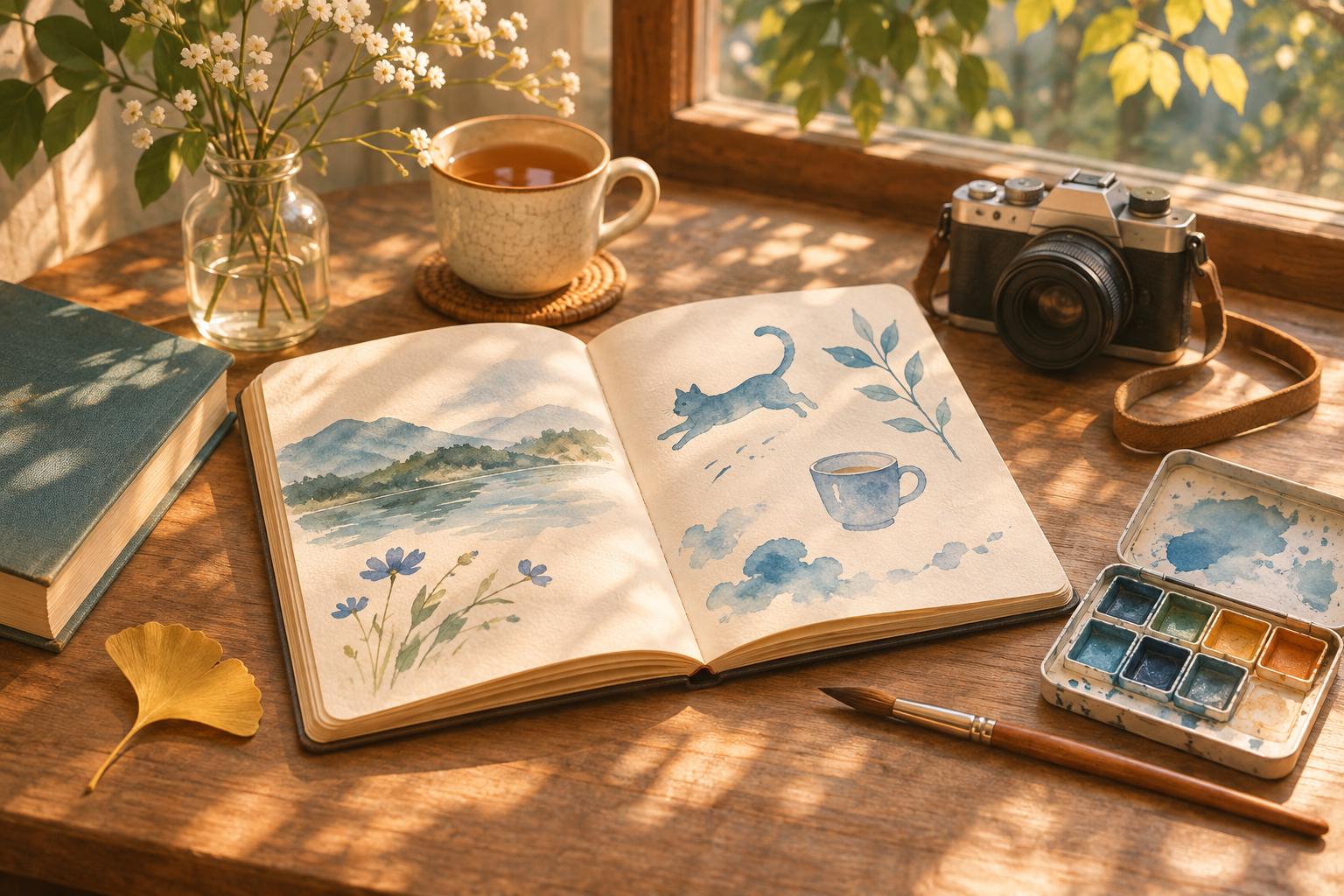
You hear a song and want to learn the piano. You read something about astronomy and want to understand the night sky. You enjoy taking photographs on a walk.
Then the questions arrive.
Am I going to take this seriously? Do I have time to get good at it? Could I make something out of this?
Before you have explored the interest, you are already negotiating a future with it.
There is another question worth asking:
What would I enjoy discovering, even if nothing came of it?
An interest can begin there. It can stay there for a while.
Let curiosity have some room
An identity can give us direction. Calling yourself a writer may help you return to the page. Seeing yourself as someone who cares for others may shape the choices you make.
But a label can also create expectations before an experience has had time to develop.
If you decide you are becoming a photographer, a blurry picture may feel like evidence against you. If you are simply learning what happens when you point a camera toward the afternoon light, the same picture gives you something to notice.
You might move closer. Try another angle. Take another picture.
The experience has room to teach you because you have not asked it to prove who you are.
You can enjoy something without building a life around it
Imagine buying a small set of paints because you like color.
During your first afternoon, you make a few uneven shapes. You enjoy watching blue spread through wet paper. Then you start wondering whether you should take a course, post your work, or open a shop.
Those possibilities may become interesting later. For now, they can wait.
You are allowed to have an afternoon with the paints.
Some interests become lasting practices. Others accompany us through a particular season. Some are enjoyable precisely because they ask so little of us.
An interest that fades can still have given you pleasure, a new perspective, or a conversation you would never otherwise have had. You can appreciate that experience without committing to repeat it forever.
Notice when enjoyment becomes an assignment
The change can be subtle.
You begin reading about a subject because it interests you. Soon, you feel behind on everything you have not read.
You start exercising in a way you enjoy. Soon, you are measuring yourself against someone else’s routine.
You make something with your hands. Before you have finished, you are evaluating whether anyone would buy it.
There is nothing wrong with studying deeply, building skill, or earning money from something you love. Those choices deserve to be made deliberately. They do not have to follow automatically from a moment of enjoyment.
When the pressure appears, pause and ask:
What did I want from this before I started imagining what it should become?
You may still want to pursue it seriously. You may want an hour of quiet. Either answer gives you useful direction.
A practice for this week: twenty minutes of curiosity
Choose one thing you have been curious about. Keep it small enough to explore with the time, energy, and materials you already have.
You might draw an ordinary object, learn a few words in another language, listen closely to an unfamiliar kind of music, or look up the name of a bird you keep seeing.
Then try this:
- Name the interest. Write: “I’m curious about __________.”
- Notice the expectation. Finish: “I feel pressure to turn this into __________.”
- Give yourself twenty minutes. Explore without planning a project, a public announcement, or a new routine. If twenty minutes feels too long, choose five.
- Leave a brief reflection. Ask: “What caught my attention? Did I enjoy any part of this? Would I like to return?”
You can return tomorrow. You can return next month. You can decide that one attempt was enough.
Let the experience inform your next choice.
Leave part of your life open
You do not need a complete explanation for everything that draws your attention.
“I wanted to try it” can be a sufficient reason.
As you change, you may discover interests that do not fit the description you have been using for yourself. Give them a little room before deciding what they mean.
Pick up the book. Make the uneven drawing. Ask the question you have been carrying.
You can decide later whether it belongs in your story. For now, you get to experience it.
What would you explore this week if you didn’t have to become anything because of it?
Subscribe to The Nomothete for more reflections and practical exercises on identity, choice, and becoming.
Before you decide what an interest means
Try writing three lines: “What I enjoy is ___.” “The commitment I actually want is ___.” “The label or expectation I can leave open is ___.” A person can enjoy taking photographs while choosing an occasional walk with a camera instead of a business or a permanent identity.
After your next attempt, ask whether you enjoyed the activity itself or mostly enjoyed imagining the person it might make you. Both observations are useful; neither requires a judgment about your worth. Keep, change, or pause the activity according to what you learn.
If you want more structure for that reflection, M.A.S.K.: Your Next Panel separates what you recognize, what you admire, what feels complicated, and what moves you toward one feasible action.
Leave a Reply