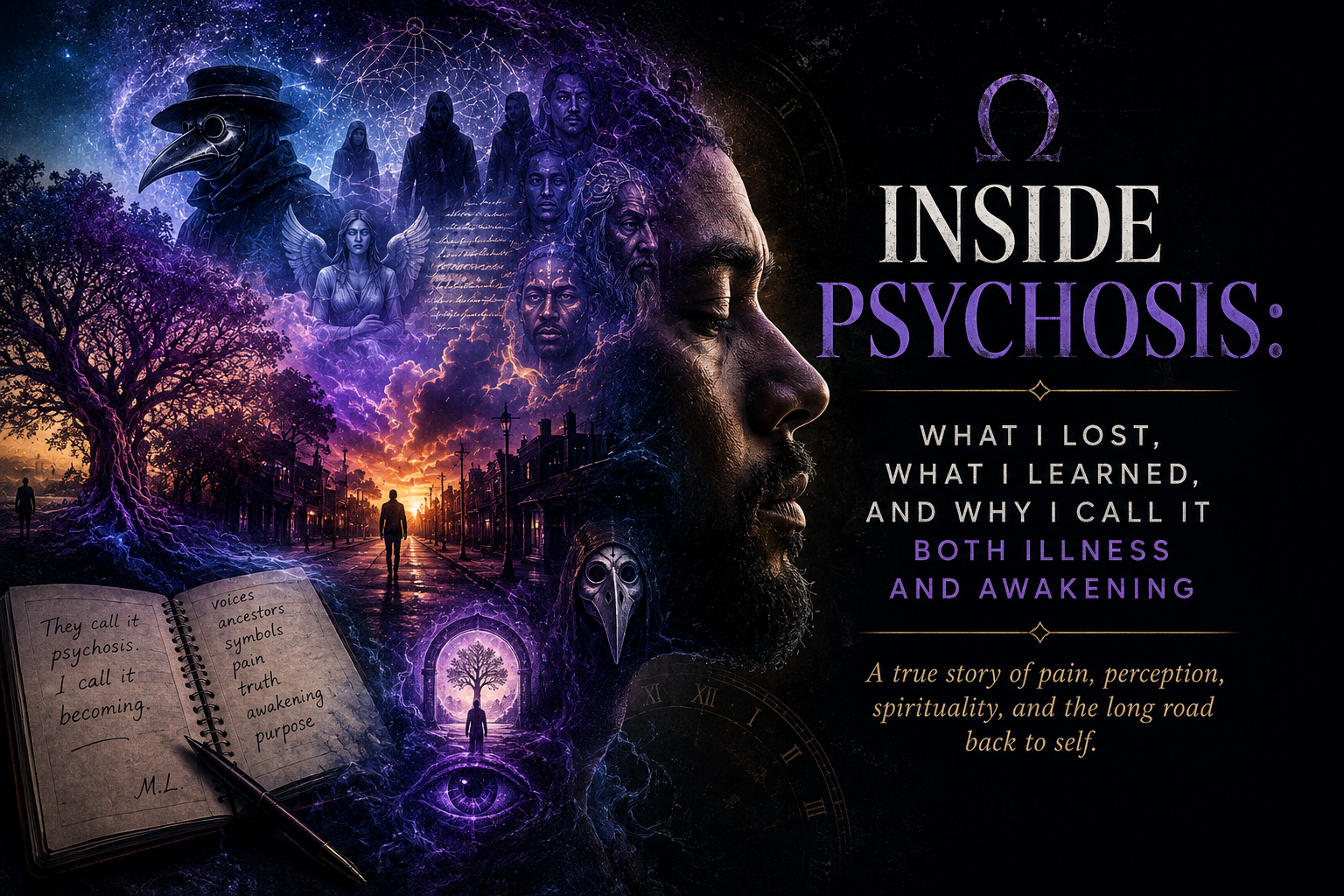
There is a version of psychosis that people often imagine from the outside.
They imagine chaos. Incoherence. Someone completely detached from reality, unable to function, unable to understand what is happening to them.
That can certainly happen.
But it is not the only way psychosis can be experienced.
My experience was more complicated.
I was terrified, angry, inspired, exhausted, creative, suspicious, productive, spiritually overwhelmed, deeply hurt, and strangely aware of what was happening to me—all at the same time.
I knew I was experiencing psychosis.
And yet, from inside it, the experience did not feel meaningless.
It felt like my entire life had been broken apart and reconstructed into symbols.
Psychologically, I understand it as psychosis.
Spiritually, I still understand parts of it as an awakening.
I have learned that I do not have to choose only one interpretation.
Before My Reality Changed
My psychosis did not begin in a vacuum.
I had been diagnosed with schizoaffective disorder when I was young, but the period leading into my major psychotic experience was filled with years of emotional strain.
I had gone through multiple painful relationships over nearly a decade. I tended to fall deeply in love, sometimes placing my partners on pedestals while overlooking what relationships were doing to me emotionally.
The final relationship before my psychosis became particularly destabilizing.
There were drugs involved. There was conflict. There was jealousy. There were lies. There were experiences that left me increasingly depressed and confused about what was happening around me.
By the time that relationship ended, I was already emotionally exhausted.
Then came isolation.
I was living with family, helping care for my grandmother, cleaning, cooking, and spending most of my time inside the house. I did not have reliable transportation. Access to my mental health care became disrupted. I increasingly felt ignored or dismissed when I tried to talk about what was hurting me.
The moment I remember as the breaking point came during a family argument.
Someone repeatedly brought up the name of an ex-partner who had become a powerful emotional trigger for me.
I asked them to stop.
I told them it was triggering me.
Instead, the name was repeated louder and louder.
I covered my ears.
I rocked.
And something inside my perception changed.
That is the moment I remember as the point where my psyche finally gave way under everything it had been carrying.
Then I Heard My Name
The voices did not begin with God.
They did not begin with angels.
They began with my name.
At first there was one voice.
Then that voice began reminding me of painful things people had said and done to me.
Memories replayed relentlessly.
I slept less.
The less I slept, the more emotionally intense everything became.
The voice told me things like:
“Grow a backbone.”
“Don’t take their shit.”
There is something psychologically interesting about that now.
The content of the voice was not random.
It was connected to something I had struggled with for years: boundaries.
For much of my life, I had swallowed what hurt me.
During psychosis, that psychological conflict became a voice.
Eventually, there were many voices.
Some sounded like people I knew.
Others I experienced as ancestors.
Others seemed like angels, gods, or spiritual beings.
At the time, they felt external.
Today, I can hold another possibility alongside that experience.
I have spent years studying mythology, religion, spirituality, psychology, symbolism, and philosophy.
When my ordinary model of reality broke down, perhaps my mind reorganized experience using the symbolic language it knew best.
My brain did not create a meaningless world.
It created a mythological one.
That does not prove that supernatural beings were literally communicating with me.
But it also does not make the experience psychologically meaningless.
That distinction has become extremely important to me.
An experience can be real without every interpretation of that experience being literally true.
The World Became Mythological
During periods of intense mania and psychosis, the world itself sometimes looked different.
There were times when everything appeared purple or bluish.
Trees and bushes seemed to transform into nature spirits, gnomes, creatures, and other beings.
People could seem angelic or demonic depending on how they treated me.
Reality had become symbolic.
Kindness looked holy.
Cruelty looked monstrous.
Pain became mythology.
Memory became prophecy.
Emotion became landscape.
The world outside of me seemed to reflect the world inside of me.
From a psychological perspective, I now find that fascinating.
Human perception is never simply a camera recording objective reality. The brain continuously interprets sensory information using memory, expectation, emotion, learned associations, and prior knowledge.
Psychosis can radically disturb that process.
Meaning becomes amplified.
Connections that would ordinarily remain separate can feel inseparable.
Internal experiences can be perceived as external events.
Symbols can become overwhelmingly significant.
For me, spirituality became one of the languages through which that altered perception expressed itself.
My “Ancestors” Told Me to Learn
Not everything I experienced during psychosis frightened me.
Some of the voices I understood as my ancestors were supportive.
They encouraged me.
They told me to study.
So I did.
I studied psychology.
Science.
Spirituality.
Project management.
Life coaching.
Peer support.
I pursued certifications.
I learned to draw.
For roughly five years, I drew constantly.
I walked several miles a day.
I spent enormous amounts of time outside.
I watched the sun rise.
I watched it set.
I cleaned my grandmother’s house.
I helped care for her.
My internal reality had become extraordinary, but much of my outward life remained surprisingly structured.
This is one of the reasons my experience does not fit neatly into the public stereotype of psychosis.
I was hallucinating.
I was experiencing profound alterations in meaning and perception.
And I was still cleaning the house.
I was still learning.
I was still walking.
I was still caring for someone.
I was still thinking about what was happening to me.
At times, I explicitly told people:
I am in psychosis.
Some friends and strangers told me they could not tell.
That does not mean I was not sick.
It means mental illness is often more complicated than our stereotypes allow.
I Felt Powerful and Small at the Same Time
Psychosis was not one emotion.
It was almost every emotion intensified.
I was terrified.
I was awe-struck.
I was angry.
I was euphoric.
I felt enlightened.
I felt persecuted.
I felt respected by beings I believed were my ancestors in ways I had often wished to feel respected by people in my ordinary life.
I experienced what seemed to be the face of God.
I experienced visions of possible futures.
I revisited memories of relationships, family conflict, betrayal, trauma, rejection, and humiliation.
It sometimes seemed as though everything painful that had ever happened to me was being presented to me simultaneously.
I felt stronger than I had ever been.
I also felt smaller than I had ever been.
But perhaps the most important thing was this:
I found my voice.
For years I had internalized pain.
During psychosis, silence became almost impossible.
That does not mean psychosis was necessary for me to develop boundaries.
It certainly does not mean psychosis should be romanticized.
But when I examine the content of my experience now, I can see psychological themes underneath the hallucinations.
There was anger about being mistreated.
There was grief.
There was abandonment.
There was loneliness.
There was a desire to be protected.
There was a desire to be believed.
There was a desire to finally say:
What happened to me mattered.
The Outside World Saw Something Different
My internal reality was enormous.
From the outside, people’s reactions varied dramatically.
Some family members saw me as “crazy” or assumed I was using drugs.
I experienced interactions with police and hospitalization as deeply traumatic.
Friends and strangers often responded differently.
Some treated me normally.
Some told me they could not tell that I was experiencing psychosis because my outward behavior had not changed in the dramatic ways people often expect.
That contrast changed the way I think about mental illness.
A diagnosis tells us something important.
It does not tell us everything about a human being.
Someone can be hallucinating and still deserve to be listened to.
Someone can be experiencing delusions and still accurately describe pain.
Someone can have impaired reality testing while retaining insight into other parts of their experience.
Someone can need psychiatric treatment without losing their dignity.
And someone can derive meaning from a psychiatric crisis without every belief they experienced during that crisis becoming objectively true.
These distinctions matter.
Coming Back Was Gradual
There was no single morning when I woke up and everything was normal again.
My return was gradual.
As I dealt with triggers, trauma, emotional pain, and the unresolved parts of my life, the psychosis became less overwhelming.
Hospitalization and medication also helped.
I think it is important for me to say that clearly.
I can believe there was psychological and spiritual meaning inside my experience while also recognizing that medical treatment played a role in my stabilization.
Those ideas do not have to be enemies.
Science does not have to erase meaning.
Spirituality does not have to reject medicine.
Psychology does not have to dismiss philosophy.
Recovery can make room for all of them while still asking a crucial question:
What is supported by evidence, and what is interpretation?
I Wrote Everything Down
One of the most important things I did during this period was write.
Every day.
I documented conversations.
I wrote down what people said.
How they said it.
What happened.
What I remembered.
Those writings matter enormously to me today because memory after intense psychological experiences can be questioned—by others and by ourselves.
When people later asked me how I could know what I remembered was accurate because I had been psychotic, I had something more than memory.
I had contemporaneous records.
Interestingly, much of what I wrote about ordinary daily interactions did not contain the more obviously psychotic material I was experiencing internally.
That does not make every perception I had accurate.
But it taught me another important lesson:
Reality testing should not mean automatically dismissing everything a person experiencing psychosis says.
We should examine claims individually.
We should look for evidence.
We should separate memory from interpretation.
We should separate experience from explanation.
That principle has become central to how I think.
Some Things Stayed With Me
Psychosis changed my relationship with perception.
Purple and blue remain deeply connected to the experience.
The omega symbol became significant to me.
So did the image of the plague doctor.
Sometimes I still look at trees and remember when they seemed capable of transforming into creatures.
Certain songs can briefly pull me back toward moments from that period.
Certain family dynamics can make me feel frighteningly close to the emotional state I was in before everything changed.
Before psychosis, I loved horror movies.
Now I have difficulty watching them.
Before psychosis, I was enthusiastic about marijuana.
Now I can barely tolerate it.
The mind remembers through more than words.
It remembers through sound.
Color.
Environment.
Music.
Bodies.
Symbols.
Associations.
That is one of the reasons recovery cannot simply mean “stop hallucinating.”
Recovery also involves learning what your nervous system remembers.
Was It Psychosis or a Spiritual Awakening?
My answer today is:
Yes.
Psychiatrically, I experienced psychosis.
I experienced voices, altered perception, unusual beliefs, intense meaning attribution, mania, and profound changes in how I interpreted reality.
I do not deny that.
But I also experienced the period as spiritually transformative.
The mistake would be thinking those two descriptions automatically cancel each other out.
Calling something a spiritual awakening does not prove supernatural causation.
Calling something psychosis does not mean it cannot change someone’s philosophy, identity, values, creativity, or relationship with existence.
I prefer a more intellectually careful position.
Perhaps some spiritual experiences are interpretations of profound psychological events.
Perhaps some psychiatric crises become spiritually meaningful because humans naturally create meaning from suffering.
Perhaps mythology gives the mind symbolic structures through which otherwise overwhelming experiences can be organized.
And perhaps we do not yet completely understand how consciousness produces experiences that can feel more real than ordinary reality.
I can live with that uncertainty.
In fact, uncertainty has taught me humility.
What Psychosis Eventually Taught Me
My experience taught me that perception is powerful but fallible.
Meaning is necessary but can become overwhelming.
Spirituality can be healing but requires grounding.
Science can explain mechanisms without exhausting meaning.
Trauma can shape perception without explaining everything.
Medication can help without answering philosophical questions.
And recovery does not always mean becoming the person you were before everything fell apart.
Sometimes recovery is becoming someone new.
This experience ultimately became part of the foundation for the work I do today.
It shaped my interest in psychology.
It deepened my fascination with consciousness and perception.
It changed how I understand spirituality.
It influenced my work in peer support and life strategy.
And it became one of the experiences behind what I now call The Multiverse of Self: my philosophical framework exploring perception, time, identity, possibility, and becoming.
The idea emerged partly from a question psychosis forced me to confront:
If my mind could construct an entire reality around me, what does that teach me about how every human being constructs their experience of the world?
Not that ordinary life is a hallucination.
Not that every reality is equally true.
But that every human being encounters reality through perception.
Perception becomes interpretation.
Interpretation becomes meaning.
Meaning influences choice.
Choice influences action.
Action repeated through time influences who we become.
That realization changed my life.
What I Would Tell Someone Entering That World
I would not tell someone experiencing psychosis that every voice is spiritual.
I would not tell them every message is true.
I would not encourage them to abandon treatment because their experience feels profound.
I would tell them something simpler:
You deserve to be listened to without everything you say being automatically believed or automatically dismissed.
Find people who can help you remain grounded.
Sleep matters.
Safety matters.
Medication may matter.
Professional treatment may matter.
Relationships matter.
Trauma matters.
Your interpretation of what is happening may change as you recover.
Write if writing helps you.
Make art if art helps you.
Walk if walking helps you.
Talk to people you trust.
Learn to distinguish between what you experience and what you can verify.
And remember that you do not have to solve the metaphysics of the universe while your nervous system is trying to survive.
There will be time for philosophy later.
First, stay here.
I No Longer Want to Choose Between Meaning and Reality
That may be the greatest lesson I took from psychosis.
I no longer believe we have to choose between treating psychological suffering seriously and asking what that suffering means.
We can do both.
We can study the brain and listen to the person.
We can respect spirituality without abandoning evidence.
We can acknowledge hallucinations without reducing someone to hallucinations.
We can challenge beliefs while respecting the human being experiencing them.
We can recognize illness without erasing transformation.
And we can acknowledge transformation without romanticizing illness.
My psychosis was one of the most terrifying experiences of my life.
It was also one of the most consequential.
I would never tell another person they need to experience what I experienced in order to grow.
But I also refuse to pretend that nothing meaningful came from it.
The person who entered that experience and the person writing this today are not the same person.
Perhaps that is what recovery has ultimately meant for me.
Not returning.
Becoming.
Thank you for today.
Thank you for yesterday.
Thank you for tomorrow.
Always remember to question your reality.
And at every end, there is a beginning.
— Mark Stephen Lyons Jr.
Founder, The Nomothete LLC
Leave a Reply