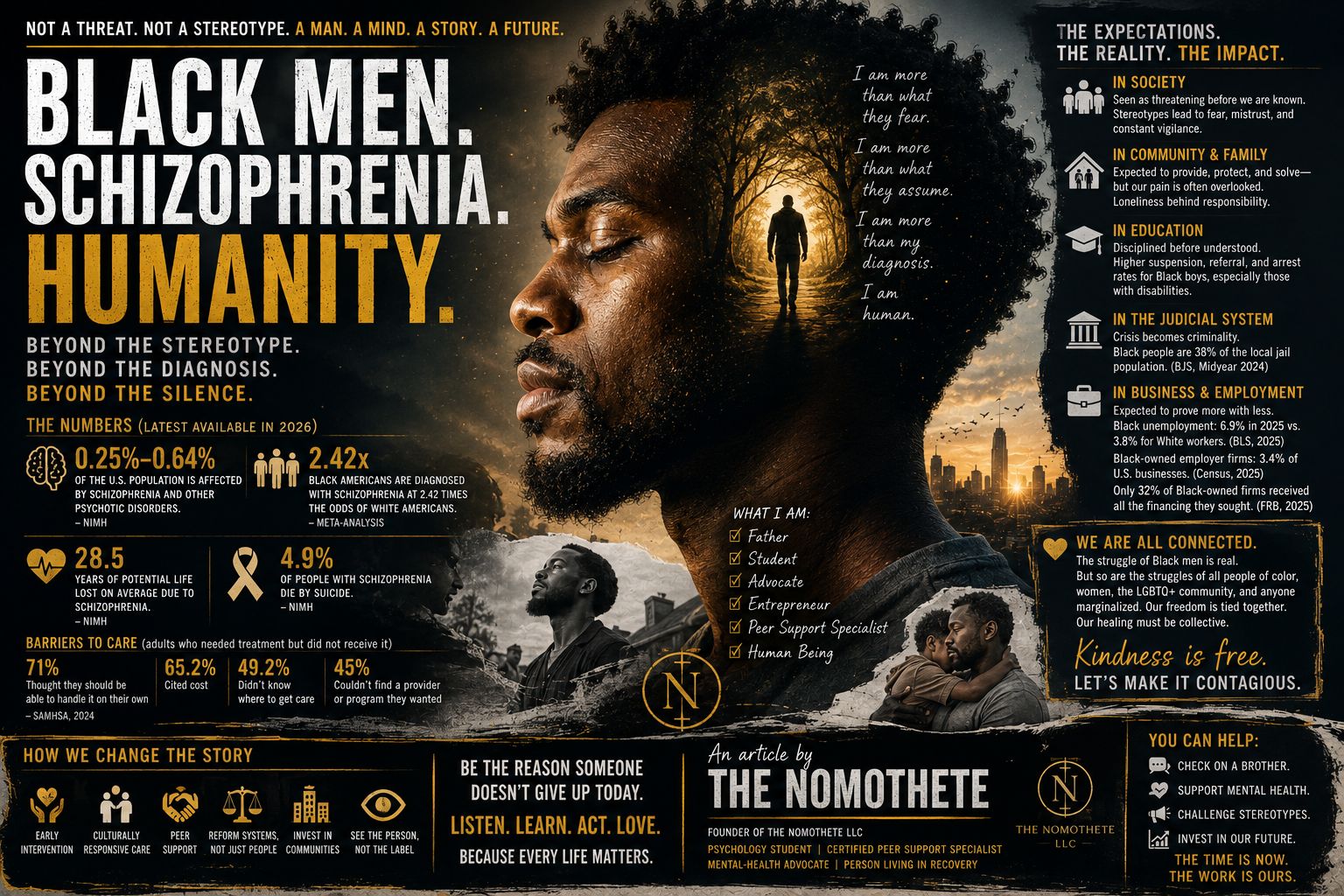
Black Men, Schizophrenia, and the Psychological Cost of Being Misread
By Mark “The Nomothete” Stephen Lyons Jr.
Founder of The Nomothete LLC, psychology student, Certified Peer Support Specialist, mental-health advocate, and person living in recovery
Kindness is free. Yet in America, Black men are often charged an extraordinary price simply for being human.
We are expected to be strong, but not intimidating. Confident, but not arrogant. Emotionally controlled, but never emotionally unavailable. Successful, but not threatening to those who did not expect us to succeed. We must advocate for ourselves without appearing aggressive, explain our pain without making anyone uncomfortable, and survive experiences that society frequently refuses to acknowledge.
For a Black man living with schizophrenia, schizoaffective disorder, autism, trauma, depression, or another serious mental-health condition, that contradiction becomes more than exhausting. It can become psychologically destabilizing.
I know this because I do not observe this problem only as a student, advocate, or life strategist. I live inside it.
I am a Black man diagnosed with schizoaffective disorder. I am also autistic. I am a father, caregiver, psychology student, business owner, writer, podcaster, peer-support professional, and advocate. Yet there are moments when I know that none of those identities will be seen first.
Sometimes the first thing people see is a Black male body.
Then they decide what that body means.
If I am quiet, I may be perceived as suspicious. If I speak passionately, I may be considered unstable. If I disagree, I may be called confrontational. If I describe an experience that another person does not understand, my credibility can disappear behind my diagnosis. I sometimes have to translate myself multiple times: once through race, once through mental illness, once through autism, and again through the expectations attached to masculinity.
That constant translation carries a psychological cost.
What the Original Study Revealed
The 2014 study African American Males Diagnosed with Schizophrenia: A Phenomenological Study was not a national prevalence study. It was a small qualitative investigation involving five African American men between the ages of 21 and 57. Its purpose was to understand how those men experienced everyday life with schizophrenia.
Four themes emerged: the men recognized that they were living with mental illness; made deliberate efforts to test reality; asserted their autonomy; and sometimes understood their different experience of reality as a source of meaning, insight, or personal uniqueness. The study emphasized that recovery should not be defined solely as the complete absence of hallucinations or unusual beliefs. A person may continue to experience symptoms while maintaining stability, autonomy, relationships, insight, and a meaningful life.
That finding matters.
Too often, professionals ask only whether symptoms remain. They do not ask whether the individual has learned to understand them, respond to them safely, maintain responsibilities, build relationships, find purpose, or participate in his own recovery.
The study also documented a troubling pattern that remains relevant: Black men were disproportionately diagnosed with schizophrenia and were more likely to be described through stereotypes involving aggression, paranoia, and violence. The researchers noted that racial stereotyping could influence how Black men seeking mental-health services were perceived and treated. They also described disparities in outpatient access, continuity of care, insurance coverage, emergency psychiatric care, and inpatient treatment.
However, we must also acknowledge the study’s limitations. Five treatment-adherent men from three nearby communities cannot represent every Black man with schizophrenia. All five received disability income, lived in the community, and had some form of outpatient treatment. Their experiences cannot establish national prevalence, prove causation, or tell us what happens to Black men who are homeless, incarcerated, uninsured, undiagnosed, untreated, or unwilling to participate in research.
Its value is not statistical generalization. Its value is human recognition.
It allowed Black men with schizophrenia to speak as people rather than being discussed only as symptoms, risks, diagnoses, or social problems.
What the Numbers Tell Us in 2026
There is an important truth about “current 2026 statistics”: national data collection takes time. As of July 2026, the newest major federal mental-health survey describes 2024, the newest annual labor estimates describe 2025, and the newest preliminary national jail report describes midyear 2024. Therefore, the most honest “2026 numbers” are the latest verified figures available during 2026—not necessarily events that occurred during 2026.
There is also no single, definitive national statistic showing the exact percentage of Black American men currently living with schizophrenia. Federal systems do not consistently cross-tabulate diagnosis, race, sex, age, institutional status, housing status, and treatment setting in one reliable estimate.
That absence is itself a public-health problem. A population cannot be fully served when it is not adequately counted.
The National Institute of Mental Health estimates that schizophrenia and related psychotic disorders affect approximately 0.25% to 0.64% of the U.S. population. NIMH acknowledges that precise estimates are difficult because psychotic disorders overlap diagnostically, studies use different methods, and many affected people are missed by household surveys—including people who are incarcerated, institutionalized, homeless, or disconnected from health care.
The condition’s consequences can be severe. NIMH reports that people with schizophrenia in the United States lose an estimated average of 28.5 potential years of life, frequently because physical illnesses are underdetected or undertreated. It also estimates that approximately 4.9% of people with schizophrenia die by suicide.
These numbers are not a verdict on anyone’s future. Recovery is possible. But they show that schizophrenia is not only a psychiatric issue. It is an issue of medical care, economic stability, housing, community belonging, suicide prevention, dignity, and human rights.
The racial diagnostic disparity remains real
A major meta-analysis found that Black Americans were diagnosed with schizophrenia at 2.42 times the odds of White Americans across the studies examined. Even when structured diagnostic instruments were used, the disparity remained, although it was smaller.
That finding does not prove that every diagnosis involving a Black patient is incorrect. Nor does it prove that the entire disparity is caused by discrimination. It does prove that the disparity is too large and persistent to dismiss.
A 2024 NIMH-supported analysis examined records from almost six million patients in a large health system. Black participants consistently had the highest rates of both affective and nonaffective psychosis diagnoses. Researchers called for further investigation of socioeconomic conditions, adverse childhood experiences, interpersonal racism, structural racism, and other social determinants of health.
We therefore need to reject two simplistic explanations.
The first is that Black people are somehow biologically destined to develop schizophrenia at much higher rates. Current evidence does not justify that conclusion.
The second is that racial bias alone explains every diagnosis. That conclusion is also too simple.
Psychotic disorders are multifactorial. Genetic vulnerability, neurodevelopment, trauma, substance exposure, sleep disruption, chronic stress, social isolation, medical conditions, family history, and environmental pressures may all interact. Racism can enter this process at several points: by increasing cumulative stress, delaying access to preventive care, shaping pathways into emergency treatment, influencing how behavior is interpreted, and affecting which diagnosis a clinician assigns.
A useful conceptual model is:
Observed Diagnostic Disparity ≈ Clinical Vulnerability + Cumulative Stress + Delayed Care + Crisis-Based Entry + Diagnostic Interpretation Bias − Protective Relationships and Early, Culturally Responsive Support
This is not a clinical formula or diagnostic instrument. It is a way of showing that the final statistic is produced by more than one force.
Why Black Men May Be Diagnosed Differently
1. The same behavior can be interpreted differently
A person’s diagnosis does not arise from symptoms alone. It also arises from someone’s interpretation of those symptoms.
Hypervigilance after trauma may be interpreted as paranoia. Emotional withdrawal may be interpreted as a negative symptom of schizophrenia rather than depression, autism, grief, exhaustion, or a learned survival response. Spiritual language may be interpreted as delusional without sufficient attention to cultural and religious context. Anger caused by humiliation, fear, or coercion may be treated as evidence of dangerousness.
Black men do not always receive the social benefit of ambiguity.
A frightened White patient may be perceived as vulnerable. A frightened Black man may be perceived as threatening.
A White patient challenging a clinician may be considered assertive. A Black male patient doing the same thing may be described as hostile, oppositional, paranoid, or lacking insight.
Bias does not require a clinician to consciously dislike Black people. It can operate through assumptions, institutional habits, time pressure, incomplete histories, poor cultural understanding, and stereotypes that influence what a professional notices first.
2. Black men often enter care through crisis rather than prevention
A man who has a regular therapist, trusted physician, secure insurance, transportation, paid time off, and family support may receive help while his symptoms are still developing.
A man without those resources may receive his first evaluation during a confrontation, emergency-room visit, involuntary commitment, arrest, or family crisis. By that point, he may be sleep-deprived, terrified, defensive, intoxicated, traumatized, confused, or unable to explain himself.
The clinician then sees the crisis but may never see the years that created it.
The 2014 study found that stigma, confidentiality concerns, mistrust, transportation problems, and gaps in access could prevent consistent care. It also found that people with serious mental illness often felt unheard and experienced interventions as coercive or threatening to their identities.
Current national data show that these barriers remain widespread. In 2024, 23.4% of U.S. adults—approximately 61.5 million people—experienced some form of mental illness, while 5.6%, or approximately 14.6 million adults, experienced serious mental illness.
Among adults with mental illness who believed they needed treatment but did not receive it, 71% said they thought they should be able to handle their mental health on their own, 65.2% cited cost, 49.2% did not know where to obtain care, and 45% could not find a provider or program they wanted to use.
That belief—I should be able to handle this by myself—is especially significant for men raised to equate strength with silence.
3. Masculinity can become a cage
Black boys frequently learn that the world may punish visible vulnerability.
“Do not cry.”
“Do not let anyone disrespect you.”
“Be the man of the house.”
“Protect your family.”
“Work twice as hard.”
“Do not give anyone a reason to fear you.”
“Do not show fear yourself.”
Some of these lessons are attempts to prepare Black boys for a difficult world. They may come from love. But when strength is defined as emotional concealment, a protective lesson can become a psychological prison.
A Black man may believe that admitting fear will make him appear weak, that seeking therapy will be used against him, or that disclosing hallucinations could lead to hospitalization, job loss, family separation, police involvement, or lifelong stigma.
The result can be delayed treatment until private distress becomes public crisis.
The Black Male Experience Across American Institutions
In Society: Seen Before We Are Known
The stereotype of the dangerous Black man has deep historical roots. It has been reproduced through political rhetoric, news coverage, entertainment, policing practices, and ordinary social interactions.
Not everyone sees Black men this way. Many people actively resist these stereotypes. But the stereotype remains influential enough to affect how quickly a Black man is feared, followed, disciplined, searched, restrained, reported, or disbelieved.
This creates what psychologists often describe as a form of vigilance: constantly monitoring one’s voice, clothing, facial expression, movements, surroundings, and emotional presentation.
Am I standing too close?
Did my tone sound angry?
Should I lower my voice?
Will reaching into my pocket be misunderstood?
Will telling the truth about my symptoms make me appear dangerous?
The mind was not designed to remain on guard indefinitely. Chronic vigilance can disrupt sleep, increase anxiety, intensify isolation, exhaust emotional regulation, and make it harder to determine whether a perceived threat is immediate, historical, symbolic, or imagined.
For a person already vulnerable to psychosis, prolonged stress and sleep disruption can worsen symptoms. That does not mean racism mechanically “causes schizophrenia.” It means that social conditions can influence when symptoms emerge, how severely they are experienced, how others interpret them, and whether the person receives support or punishment.
In Community and Family: Needed, but Not Always Nurtured
Black men are frequently expected to provide, protect, solve problems, remain composed, and carry responsibilities without complaint.
A man may be valued for what he supplies but not asked what he needs.
He may be the person everyone calls during a crisis, yet have no one to call during his own. He may be expected to support children, partners, parents, relatives, friends, coworkers, and community members while privately questioning whether anyone would notice if he began to disappear emotionally.
There is a profound difference between being needed and being cared for.
Loneliness is not simply the absence of people. It is the absence of a place where a person can be fully known without being punished for what is revealed.
The original study described a “Close Community” of trusted family members, friends, peers, and therapists who accepted the men’s individuality. It contrasted that support with an “Outside Community” that judged, rejected, stigmatized, or underestimated them. The men wanted the public to understand that a diagnosis did not make them violent, immoral, incapable, or less human.
Every Black man experiencing mental distress needs a Close Community—not a collection of people who control him, but people who listen, help him test reality, respect his autonomy, notice changes, protect his dignity, and intervene before crisis becomes catastrophe.
In Education: Disciplined Before Being Understood
Black boys often encounter adultification: they may be perceived as older, less innocent, more responsible for their behavior, and more threatening than children of the same age from other groups.
Behavior that might lead another child to counseling, evaluation, accommodation, or patient correction may lead a Black boy to suspension, removal, police referral, or arrest.
A 2024 Government Accountability Office report, using the most recent national student-arrest data available, found that Black, American Indian or Alaska Native, and Native Hawaiian or Pacific Islander students were arrested at school at two to three times the rate of White students. Boys from these groups who had disabilities experienced even higher arrest rates.
This is especially important for Black boys with autism, attention difficulties, trauma histories, learning disabilities, emotional dysregulation, or emerging psychiatric symptoms.
When disability is treated as defiance and distress is treated as danger, schools can become the first institution to teach a child that he is a problem rather than a person experiencing a problem.
Educational exclusion then affects graduation, employment, income, social connection, health insurance, housing, and future contact with the justice system. Mental health cannot be separated from these conditions.
In the Judicial System: Crisis Becomes Criminality
At midyear 2024, U.S. local jails held approximately 657,500 people. Black people represented 38% of the local jail population.
Not every racial disparity proves discrimination in every individual case. Crime patterns, neighborhood conditions, police deployment, poverty, charging decisions, bail practices, legal representation, sentencing, and many other variables contribute. But the scale of racial overrepresentation requires an institutional explanation, not a biological one.
For Black men living with mental illness, a behavioral-health crisis can easily become a law-enforcement event.
Disorganized speech may be interpreted as noncompliance. Fear may become resistance. Confusion may look like defiance. Paranoia may intensify when armed strangers issue commands. Autism may affect eye contact, communication, sensory regulation, or response speed. Trauma may produce fight, flight, freeze, or dissociation.
Once a person enters the justice system, treatment can become fragmented. Medication may change. Medical records may not transfer. Housing and employment may be lost. Family relationships may deteriorate. The experience of arrest, confinement, restraint, or isolation can add new trauma to the condition that produced the crisis.
America must decide whether mental illness will be met first with care or control.
In Employment and Business: Expected to Prove More With Less
A Black man in the workplace may feel pressure to be exceptionally competent while remaining nonthreatening. Mistakes may be interpreted as confirmation of stereotypes. Confidence may be seen as arrogance. Direct communication may be perceived as aggression. Mental-health disclosure may threaten advancement, credibility, or job security.
The latest annual labor estimates available in 2026 show that the Black unemployment rate averaged 6.9% in 2025, compared with 3.8% for White workers. The Bureau of Labor Statistics notes that the 2025 figures are based on 11 months because October data were not collected during the federal shutdown.
Among full-time wage and salary workers in 2025, Black men had median weekly earnings of approximately $1,039, compared with $1,354 for White men.
Entrepreneurship is often presented as the escape from workplace discrimination, but business ownership brings its own barriers. Census data released in 2025 showed that Black-owned companies represented only 3.4% of U.S. employer firms, approximately 201,000 businesses.
Federal Reserve survey data reported that only 32% of Black-owned employer firms applying for credit received the full amount of financing they sought in 2025. Because the Small Business Credit Survey is a convenience sample rather than a random national sample, the figure should be interpreted cautiously, but it still signals a significant financing challenge.
A Black male entrepreneur living with mental illness therefore may have to manage symptoms, stigma, inconsistent income, credit barriers, family responsibilities, public expectations, and the pressure to make his business prove his personal worth.
That is not merely “stress.” It is cumulative load.
How I Carry These Realities Every Day
I deal with these tensions by refusing to let any single label become the total definition of my life.
I live with schizoaffective disorder, but I am not reducible to schizoaffective disorder.
I am autistic, but autism does not erase my intelligence, empathy, spirituality, creativity, or capacity for leadership.
I am a Black man, but I am not the collection of fears that other people may project onto Black men.
My recovery requires active work. I build structure into my days. I study psychology, philosophy, science, and spirituality so that I can better understand my experiences. I write, create, advocate, and speak. I use grounding, journaling, reflection, education, trusted relationships, and reality-testing. I pay attention to sleep, stress, sensory overload, emotional changes, and the difference between meaningful insight and an interpretation that needs to be questioned.
I have learned that reality-testing is not an admission of weakness. It is an act of intellectual humility.
I ask:
What evidence supports this perception?
What evidence challenges it?
Is this danger happening now, or is my nervous system remembering an earlier danger?
Am I responding to a person, or to what that person represents to me?
Have I slept?
Am I isolated?
Who can help me examine this without humiliating me?
I also build meaning from what I have survived. That does not mean every symptom is spiritually true or that suffering should be romanticized. It means that a person can create wisdom from an experience without treating every perception produced during that experience as objective fact.
My work through The Nomothete is partly an answer to the loneliness I have known. I want to help create the kind of Close Community that too many people never receive: one that combines compassion with accountability, spirituality with reality, science with meaning, and autonomy with responsible support.
Still, there are days when it feels as though society does not care what happens to a Black man unless he is producing, protecting, entertaining, winning, or dying publicly enough to become a symbol.
There are days when loneliness is not the absence of love. It is the exhaustion of wondering whether people love the whole person or only the version of him that causes them no discomfort.
That feeling is not proof that nobody cares. But it is a real emotional consequence of repeatedly being treated as though one’s pain is less urgent, one’s fear is more dangerous, and one’s vulnerability is less believable.
National survey findings show that this feeling is not mine alone. Among adults with an unmet need for mental-health treatment, some reported believing that no one would care whether they got better.
A society should be disturbed whenever a person concludes that his recovery would not matter to anyone.
How We Can Change the Statistics
We will not change the numbers through awareness campaigns alone. We need measurable institutional reforms.
1. Improve diagnostic accuracy
Clinicians should avoid making permanent conclusions from a single crisis encounter whenever immediate safety permits a fuller assessment.
Evaluations should examine mood disorders, trauma, autism, substance effects, sleep deprivation, medical conditions, medication effects, cultural beliefs, spiritual traditions, family observations, and the person’s functioning over time.
Health systems should audit diagnostic patterns by race, gender, age, clinician, setting, use of restraints, involuntary treatment, and diagnostic changes. Disparities should trigger review, not defensiveness.
2. Replace crisis-only care with early intervention
People experiencing early psychosis need coordinated specialty care, family education, supported employment or education, peer support, psychotherapy, medical treatment, substance-use support, and practical assistance.
Help should arrive before homelessness, arrest, family collapse, or repeated hospitalization.
3. Build Black male peer-support networks
The original study found that peer support, family involvement, and trusted outpatient relationships were central to stability. Four of the five participants regularly attended peer-support activities, and two worked as peer counselors.
Black men need places where they can speak without performing invulnerability. Peer specialists can help translate between clinical systems and lived experience while demonstrating that diagnosis does not eliminate leadership, wisdom, employment, or recovery.
4. Bring support into trusted community spaces
Mental-health education should be available in barbershops, churches, colleges, community centers, reentry programs, workplaces, sports organizations, libraries, and Black-owned businesses.
Community-based services should not replace professional care when professional care is necessary. They should become bridges to it.
5. Reform school discipline
Schools should reduce exclusionary discipline, strengthen disability assessment, expand counselors and social workers, train staff in trauma and autism, and examine racial disparities in suspensions, police referrals, restraints, and arrests.
A distressed child should not have to become an incarcerated adult before society asks what happened to him.
6. Create non-police behavioral-health responses
Communities need trained mobile crisis teams that can respond without law enforcement when no immediate violent threat is present. When police involvement is necessary, behavioral-health professionals and peer specialists should participate whenever possible.
The goal must be stabilization, not domination.
7. Expand diversion and continuity of care
Courts and correctional systems should increase mental-health diversion, pretrial support, medication continuity, discharge planning, housing assistance, peer navigation, and connection to outpatient care.
Release without treatment, identification, transportation, medication access, or housing is not rehabilitation. It is a planned relapse into crisis.
8. Address economic determinants
Mental-health advocacy must include living wages, stable housing, accessible insurance, transportation, food security, family leave, fair lending, and business capital.
Therapy cannot compensate for every structural injury. A person cannot meditate his way out of eviction, journal his way into health insurance, or positive-think his way through discriminatory lending.
9. Redefine strength
Strength is not silence.
Strength is recognizing a problem before it controls your life.
Strength is asking for help while you can still participate in choosing what that help looks like.
Strength is telling another man, “You do not have to carry this alone.”
10. Collect better data
National agencies should publish intersectional statistics that show how diagnosis and treatment vary by race, sex, age, disability, sexuality, geography, income, housing status, incarceration, and treatment setting.
We cannot correct what we refuse to measure.
This Is Larger Than Black Men
The suffering of Black men should be addressed directly, not diluted into a vague statement that “everyone struggles.” Specific problems require specific attention.
But advocacy must not become a competition over who has suffered most.
Many people of color face cultural misunderstanding, discrimination, unequal care, economic barriers, and criminalization. Women continue to experience violence, medical dismissal, economic inequality, caregiving burdens, and gendered expectations. LGBTQ+ people face rejection, discrimination, family estrangement, violence, and barriers to affirming care. People living at several of these intersections may experience multiple systems of pressure simultaneously.
The Centers for Disease Control and Prevention recognizes that racial and ethnic minorities, women, and LGBTQIA+ people can experience disproportionate mental-health burdens connected to discrimination, poverty, unemployment, and reduced access to appropriate care.
Solidarity does not require us to pretend that every group experiences the same form of harm. It requires us to understand that dehumanization changes its language depending on whom it targets.
The stereotype applied to a Black man may be dangerousness.
The stereotype applied to a woman may be irrationality.
The stereotype applied to an LGBTQ+ person may be deviance.
The stereotype applied to an immigrant may be foreignness.
The stereotype applied to a person with schizophrenia may be incompetence or violence.
Different stereotypes can serve the same function: making it easier to disregard another person’s humanity.
We must therefore support one another without erasing our differences.
Black men must stand for Black women and girls.
Men must stand against misogyny.
Cisgender and heterosexual people must defend LGBTQ+ people.
People without disabilities must defend disabled people.
Communities of color must confront prejudice within our own communities as well as prejudice directed toward us.
Mental-health advocates must reject racism, sexism, homophobia, transphobia, ableism, classism, and every belief system that decides some lives deserve less dignity than others.
Kindness Is Free—but Justice Requires Action
Kindness is not passive politeness.
Kindness is listening before labeling.
It is asking what happened before deciding what is wrong.
It is learning a person’s history before interpreting his behavior.
It is recognizing fear beneath anger, pain beneath withdrawal, trauma beneath vigilance, and humanity beneath diagnosis.
It is refusing to share jokes that portray mental illness as dangerousness.
It is checking on the strong person.
It is supporting Black-owned businesses, peer-support programs, community mental-health organizations, crisis alternatives, and policies that expand access to care.
It is challenging a clinician, teacher, employer, police officer, family member, or friend when a Black man’s behavior is being interpreted through a stereotype rather than evidence.
It is also respecting accountability. Compassion does not require ignoring dangerous behavior, denying symptoms, romanticizing psychosis, or treating every unusual belief as spiritual revelation. Real kindness helps a person remain safe, examine reality, take responsibility, access appropriate treatment, preserve autonomy whenever possible, and construct a life larger than his diagnosis.
A Call to Action
I am asking clinicians to examine not only the patient’s mind but also the assumptions brought into the room.
I am asking schools to counsel before criminalizing.
I am asking courts to divert people into treatment before trapping them in cycles of incarceration.
I am asking communities to make vulnerability possible for men.
I am asking families to listen without ridicule and intervene without stripping away dignity.
I am asking business leaders to judge Black men by evidence, performance, character, and potential—not inherited stereotypes.
I am asking mental-health organizations to hire and compensate people with lived experience, especially Black male peer-support specialists.
I am asking Black men to check on one another, speak honestly, seek help earlier, and stop treating silent suffering as proof of strength.
I am asking every person reading this to choose one concrete act: contact someone who has become isolated, support a peer-led organization, challenge a stereotype, learn the signs of psychosis, advocate for crisis-response reform, mentor a Black boy, fund a Black-owned business, or simply ask a man how he is doing—and remain present long enough to hear the real answer.
Because kindness is free.
Attention is free.
Listening is free.
Human dignity should never have been expensive.
And we must leave ourselves with one final question:
If a society repeatedly treats a man as dangerous, disposable, or unbelievable—and then diagnoses the distress created or intensified by that treatment without examining its own behavior—who is failing the reality test: the man, or the society?
Leave a Reply