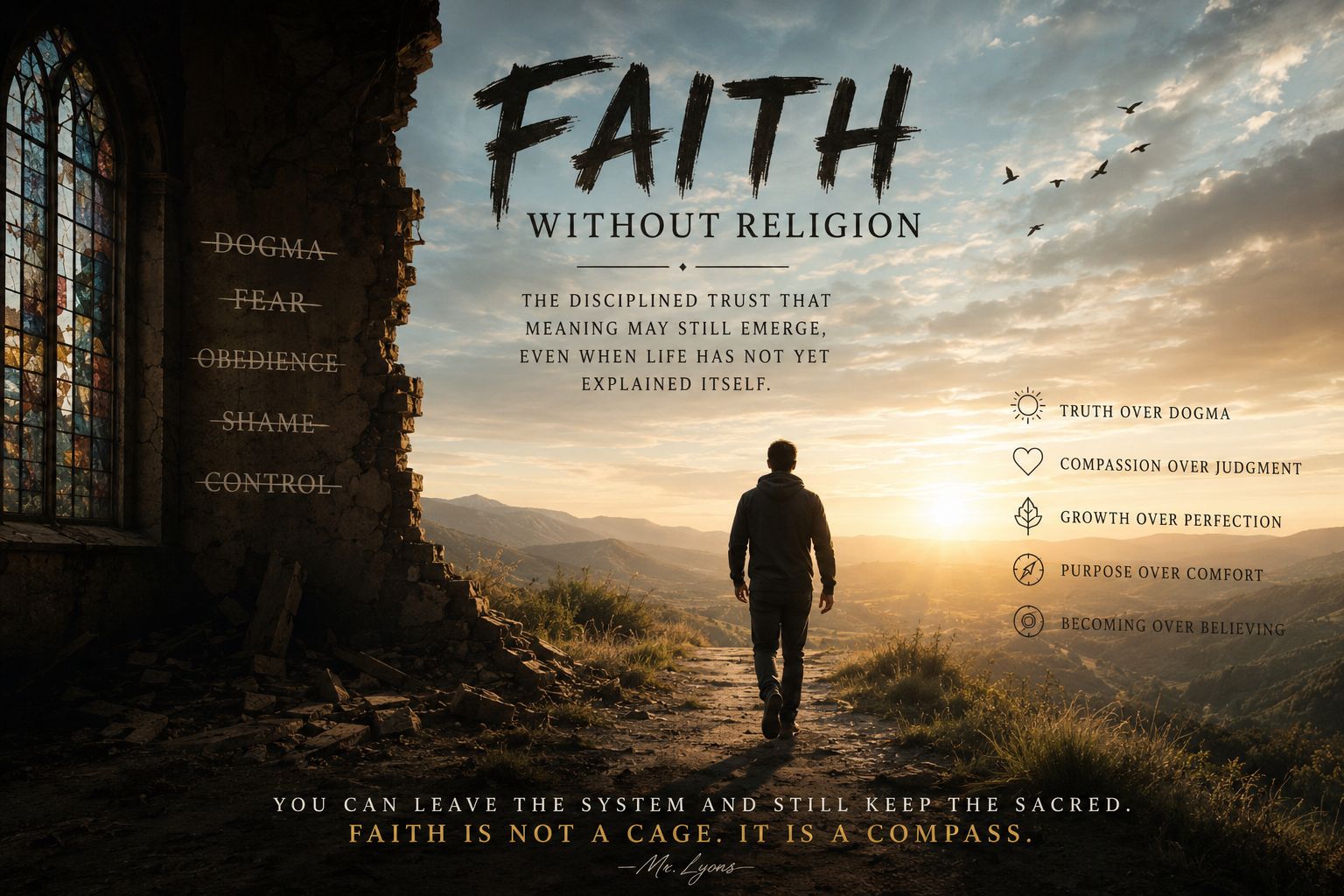
A person can lose belief in religion and still keep faith.
That statement may sound contradictory to some people, especially if they were raised to believe that faith belongs only inside a church, mosque, temple, scripture, doctrine, or inherited tradition. But faith is older than every institution that tries to define it. Faith is not always belief in a religious system. Sometimes faith is the quiet force that helps a person keep living when certainty has collapsed.
Religion is a structure.
Faith is an orientation.
Religion gives faith language, ritual, story, community, law, and tradition. At its best, religion can hold a person through grief, give moral shape to a life, preserve ancient wisdom, and connect individuals to something larger than themselves. But religion is not the only place where faith can exist. Faith can survive outside of doctrine. It can live in the artist who keeps creating after devastation. It can live in the parent who keeps showing up for their children while silently carrying pain. It can live in the survivor who no longer believes the world is safe but still believes healing is possible.
That is faith.
Not blind obedience.
Not denial.
Not pretending to know what cannot be known.
Faith is the disciplined trust that meaning may still emerge, even when life has not yet explained itself.
Religion Is Not the Same Thing as Faith
Religion is usually organized. It has teachings, sacred texts, rituals, leaders, moral codes, symbols, and communities. It offers a map of reality. It tells people where they came from, why they suffer, what matters, how to live, and what may come after death.
Faith is more intimate.
Faith is the interior movement of trust. It is the decision to orient oneself toward meaning, goodness, truth, healing, or becoming, even without perfect proof. A religious person may have faith, but a nonreligious person may have faith too. An atheist can have faith in human dignity. An agnostic can have faith in the search for truth. A spiritual person can have faith in the mystery of existence without accepting a formal creed.
This distinction matters because many people leave religion after being wounded by it. Some were shamed, controlled, manipulated, silenced, or taught to fear themselves. Others simply grew beyond the explanations they were given. Some could no longer accept doctrines that conflicted with their conscience, their reason, their experience, or their understanding of human suffering.
But leaving religion does not mean a person has abandoned the sacred.
Sometimes it means they are trying to find it without coercion.
Sometimes it means they are searching for a form of truth that does not require them to betray their own mind.
Faith Is Not the Enemy of Reason
One of the great mistakes of modern culture is assuming that faith and reason must be enemies. That is too simple.
Faith becomes dangerous when it refuses evidence, denies harm, excuses abuse, or demands obedience over conscience. But faith itself does not have to be irrational. There is a mature kind of faith that does not reject reason. It works beside reason.
Reason asks, “What can be known?”
Faith asks, “How do I live with what remains unknown?”
Science can tell us many things about the brain, trauma, attachment, emotion, memory, behavior, and human flourishing. It can help us understand why people suffer, what treatments work, how communities affect health, and how meaning-making changes the nervous system. But science does not eliminate the existential weight of being human. It does not remove grief. It does not erase death. It does not give every person a reason to get out of bed after their world has collapsed.
That is where faith enters—not as a replacement for science, but as a companion to the human condition.
Faith does not need to make false claims to be useful. It does not have to say, “Everything happens for a reason.” That phrase can become cruel when spoken to someone in deep pain. A wiser faith says, “Not everything that happens is good, but meaning can still be made. Not every wound was necessary, but healing may still be possible. Not every loss can be explained, but love can still remain.”
That is not irrational.
That is survival with depth.
The Psychology of Faith
Psychologically, faith can function as a stabilizing force. Human beings need more than facts. We need meaning. We need coherence. We need some inner reason to continue when our circumstances become painful, confusing, or uncertain.
Faith can help organize the self when life feels chaotic. It can give the mind a future to move toward. It can provide emotional endurance when immediate evidence is discouraging. A person in recovery may not fully believe they are healed, but they may have faith that healing is possible. A grieving person may not feel whole, but they may have faith that life can still contain beauty. A person emerging from trauma may not trust the world yet, but they may have faith that their nervous system can learn safety again.
This kind of faith is not fantasy. It is an orientation toward possibility.
The brain often needs an image of the future before the body can move toward it. Hope, purpose, and meaning are not decorations on life. They are organizing forces. They shape attention, behavior, emotion, and resilience. When a person believes that tomorrow can be different, even slightly different, they act differently today.
Faith is not always a belief about heaven.
Sometimes faith is the decision not to surrender the future to the pain of the past.
The Philosophy of Faith
Philosophically, faith begins where certainty ends.
Human beings want certainty because uncertainty makes us vulnerable. We want to know why we are here, what is right, whether our suffering matters, and whether anything beyond death exists. But the deepest questions of life rarely give us complete answers. We live inside mystery whether we admit it or not.
That does not mean all beliefs are equally true. It does not mean we should abandon logic. It means we should be honest about the limits of human knowing.
There is a difference between certainty and commitment.
Certainty says, “I know beyond doubt.”
Faith says, “I do not know completely, but I choose how I will live.”
That choice matters. A person may not know whether the universe has ultimate meaning, yet still choose to live as if compassion matters. A person may not know whether God exists, yet still choose humility before the mystery of being. A person may not accept religious doctrine, yet still feel reverence when looking at the stars, listening to music, holding a child, surviving a breakdown, or witnessing the strange resilience of the human spirit.
Faith is not always an answer.
Sometimes faith is a posture.
It is the way the soul stands before the unknown.
Spirituality Without Dogma
Spirituality without religion is not necessarily shallow. It can be deeply disciplined when approached with honesty.
To be spiritual outside religion is not simply to collect comforting ideas. It is not taking beautiful language from every tradition while avoiding responsibility. True spirituality still requires ethics, humility, practice, self-examination, and service. Without those, spirituality can become ego dressed in cosmic language.
A mature nonreligious faith asks:
What kind of person am I becoming?
How do I treat people when I am afraid?
What do I worship through my habits?
What do I serve with my attention?
What kind of meaning am I creating through my choices?
These questions matter more than labels. A person can attend religious services every week and still be cruel, arrogant, or dishonest. Another person may never enter a sanctuary and still live with compassion, discipline, reverence, and moral courage.
The sacred is not proved by vocabulary.
It is revealed through transformation.
The Danger of False Faith
Faith is powerful, but it must be purified by truth.
There is a form of faith that heals, and there is a form of faith that imprisons. False faith tells people to ignore evidence, tolerate abuse, suppress doubt, obey corrupt authority, or call suffering holy when it is actually preventable. False faith demands that people abandon their discernment. It confuses loyalty with goodness. It mistakes fear for devotion.
That is not faith at its highest level.
That is control.
Real faith can survive questions. It does not need to silence the mind. It does not collapse when examined. A mature faith welcomes doubt because doubt can cleanse belief of arrogance. Doubt is not always the enemy of faith. Sometimes doubt is the immune system of the spirit.
If a belief cannot survive compassion, reason, evidence, and honest questioning, then it may not be faith. It may be fear wearing sacred clothing.
This is why people must be careful with the word “faith.” Faith should not be used to manipulate the vulnerable. It should not be used to excuse harm. It should not be used to prevent someone from seeking therapy, medication, community support, legal protection, or medical care. Faith should deepen a person’s relationship with reality, not sever them from it.
The highest form of faith does not make a person less honest.
It makes honesty survivable.
The Equation of Living Faith
A simple way to understand this is:
Living Faith = Meaningful Trust × Embodied Action ÷ the Demand for Certainty
Faith grows when trust becomes action.
It weakens when a person demands perfect certainty before taking the next step.
This does not mean people should act recklessly. It means life often requires movement before full clarity arrives. Healing begins before you feel healed. Purpose begins before you feel ready. Love begins before every fear disappears. Transformation begins before the old self fully understands the new one.
Faith is not passive.
Faith is embodied.
It is not merely saying, “I believe.”
It is asking, “What does my life become if I trust this enough to practice it?”
If I have faith in healing, I must participate in healing.
If I have faith in truth, I must stop lying to myself.
If I have faith in love, I must become more loving in practice.
If I have faith in becoming, I must make choices that allow a new self to emerge.
This is where faith becomes more than an idea. It becomes a method of living.
Faith as Becoming
In my own language, faith is not merely belief in something above us. Faith is the bridge between who we have been and who we are becoming.
There are moments in life when the old identity collapses. The person we were no longer works. The story we inherited no longer explains us. The pain we carried becomes too heavy. The mask cracks. The nervous system protests. The soul, or psyche, or deepest self begins demanding a new relationship with reality.
Some call that a crisis.
Some call it awakening.
Sometimes it is both.
In those moments, religion may help some people. For others, religion may not be the container they need. What they need is faith in becoming itself: faith that the self is not finished, faith that perception can change, faith that time can be re-entered differently, faith that the future is not merely a repetition of the wound.
This is not naïve optimism. It is not pretending that suffering disappears when we think positively. It is the deeper discipline of refusing to let suffering have the final authorship over the self.
Faith says:
I am not only what happened to me.
I am not only what I lost.
I am not only what I feared.
I am not only what I was taught to believe.
I am still becoming.
That is sacred, whether or not a person calls it religious.
Why This Matters Now
Many people today are spiritually hungry but institutionally distrustful. They are not empty. They are not immoral. They are not faithless. They are tired of systems that ask for obedience without accountability. They are tired of leaders who preach love while practicing domination. They are tired of being told that questioning is rebellion when sometimes questioning is the beginning of wisdom.
But the answer to harmful religion is not necessarily a life without meaning. The answer may be a deeper, more honest faith.
A faith that can sit with science.
A faith that can survive grief.
A faith that can respect mystery without inventing false certainty.
A faith that can honor ancient wisdom without becoming trapped by ancient fear.
A faith that can say, “I do not know everything, but I will live with reverence, courage, and responsibility.”
That kind of faith may be exactly what many people are searching for.
Not a religion to control them.
Not a doctrine to shrink them.
Not a label to perform.
But a living trust that helps them become more whole.
The Sacred Outside the Walls
Religion is a house built around faith.
For some people, that house is beautiful. It gives shelter, language, ancestry, rhythm, and belonging.
For others, the house became too small, too violent, too rigid, or too full of rooms they were forbidden to question. So they stepped outside.
But outside the house, the sky is still there.
The mystery is still there.
The need for meaning is still there.
The call to love, heal, grow, serve, and become is still there.
Faith does not end just because religion no longer holds it. Sometimes faith begins again when it is finally freed from fear.
A person can have faith without believing in religion because faith is not owned by institutions. Faith belongs to the human struggle to keep meaning alive inside uncertainty. It belongs to the wounded person who still chooses healing. It belongs to the thinker who refuses easy answers. It belongs to the seeker who honors mystery without surrendering reason. It belongs to anyone who has stood at the edge of despair and decided that tomorrow still deserves a chance.
That is faith.
Not the denial of reality.
The courage to keep becoming inside it.
Leave a Reply